


Switching to solar is no longer just about saving the planet; it’s about saving your hard-earned money and securing your energy future. Whether you run a busy household or a growing business, rising electricity bills are a constant stress. An on-grid solar system converts your empty rooftop into a revenue-generating asset.
This guide will walk you through everything you need to know from how the system works to the costs and subsidies available in India so you can hire the right On-grid Solar Installer and make the switch with confidence.
Overview: What Is an On‑Grid Solar System?
An on-grid solar system (also known as a grid-tied system) is the most common and cost-effective solar solution for homes and businesses. Unlike off-grid systems that require expensive batteries to store power, an on-grid system works in tandem with your local utility grid.
Think of the grid as a giant virtual battery.
When your solar panels generate more electricity than you need during the day, the excess is sent back to the grid. At night, when your panels are sleeping, you draw power from the grid as usual. The magic happens at the end of the month: you only pay for the “net” difference.
If you export more than you consume, the electricity board (DISCOM) may even owe you money credits. It is the simplest way to erase your electricity bill.
Key Components and How an On‑Grid System Works
An on-grid system is an engineering marvel that operates silently on your roof.
Here are the four heroes of the system:
- Solar Panels (PV Modules): These capture sunlight and convert it into Direct Current (DC) electricity. In 2026, high-efficiency Bifacial or TOPCon panels are the standard, capable of generating power even in lower light.
- Solar Inverter: This is the “brain” of the system. It converts the DC electricity from panels into Alternating Current (AC), which powers your home appliances.
- Balance of System (BoS): This includes the mounting structures that hold panels against high winds, AC/DC distribution boxes (safety switches), and high-quality cables.
- Net Meter: The most critical component for savings. This bi-directional meter records both the power you import from the grid and the power you export to it, allowing for the “banking” of units.
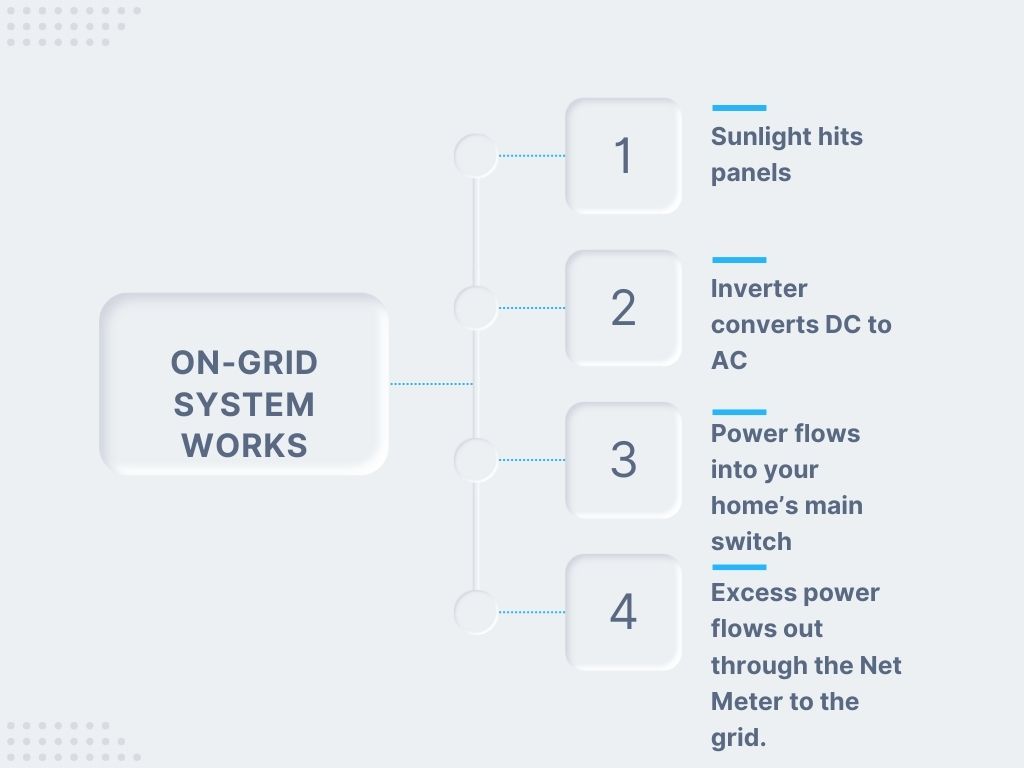
How it works: Sunlight hits the panels -> DC power goes to the Inverter -> AC power runs your fans and ACs. If you generate 5kW but use only 2kW, the remaining 3kW flows automatically through the Net Meter to the grid, earning you credits.
Who Is an On‑Grid Solar Installer and What Do They Do?
An On-grid Solar Installer is not just a technician who bolts panels to your roof; they are your turnkey project manager. In India, the bureaucratic process of getting a solar meter sanctioned is often harder than the installation itself.
A professional installer manages the entire lifecycle:
- Site Survey: They analyze your shadow-free area and load requirements.
- Engineering Design: They calculate the perfect tilt and structure weight to ensure safety.
- Procurement: They source ALMM-approved (government certified) modules to ensure you get your subsidy.
- Liaisoning: Perhaps their most valuable service is handling the paperwork with your local DISCOM (Distribution Company) to commission the net meter.
Solar Subsidy for On‑Grid Systems in India
The Government of India has aggressively promoted rooftop solar to meet its 2026 renewable targets.
The primary scheme for homeowners is the PM Surya Ghar: Muft Bijli Yojana.
- For Homeowners: The subsidy (Central Financial Assistance) is substantial. While rates can vary slightly by state policy updates, the central scheme generally covers a significant percentage of the benchmark cost for systems up to 3 kW. This direct transfer to your bank account drastically reduces your Return on Investment (ROI) period to just 3-4 years.
- For Commercial Properties: While direct capital subsidies are usually reserved for residential sectors, commercial entities benefit from Accelerated Depreciation (AD). Businesses can write off ~40% of the system value in the first year, significantly reducing their tax burden.
Note: To avail of these subsidies, you must use domestically manufactured solar modules listed under the ALMM (Approved List of Models and Manufacturers).
On‑Grid Solar System Sizes (1 kW–10 kW) and Typical Price Range
Choosing the right size depends on your monthly electricity bill. A 1 kW system typically generates 4-5 units (kWh) per day. Below is a typical price range for Tier-1 equipment in Indian cities for 2026.
| System Capacity | Suitable For | Avg. Monthly Bill Offset | Est. Price Range (Before Subsidy)* |
| 1 kW – 2 kW | Small homes (Fans, Lights, TV) | ₹1,000 – ₹2,500 | ₹60,000 – ₹1,30,000 |
| 3 kW | 2-3 BHK (AC + Appliances) | ₹3,000 – ₹4,500 | ₹1,60,000 – ₹1,90,000 |
| 5 kW | Large Homes / Small Offices | ₹5,000 – ₹8,000 | ₹2,50,000 – ₹3,20,000 |
| 10 kW | Villas / Commercial Shops | ₹10,000 – ₹15,000 | ₹4,50,000 – ₹5,50,000 |
Prices vary based on state, structure elevation, and panel technology (e.g., Bifacial vs. Mono-PERC).
How to Choose the Right On‑Grid Solar Installer
Your solar system is a 25-year asset. Picking the wrong installer can lead to leaky roofs, poor generation, or zero service.
- Check Certifications: Ensure they are empaneled with your state’s renewable energy nodal agency or the Ministry of New and Renewable Energy (MNRE).
- ALMM Compliance: Ask explicitly if they provide ALMM-listed panels. Non-approved panels will disqualify you from the subsidy.
- Service Track Record: Solar needs little maintenance, but if your inverter trips, you need someone who answers the phone. Look for local reviews rather than just national brand names.
- Site Visit Quality: Did they fly a drone or climb the roof?
Did they check your sanctioned load?
A quote without a site visit is a red flag.
Choose the Right Partner for Your Home or Business – Best On-Grid Solar Installers
Advantages and Disadvantages
Advantages:
- Massive Savings: You can eliminate up to 90% of your electricity bill.
- Passive Income: Net metering allows you to earn credits for unused electricity.
- Maintenance Free: With no batteries to replace, the system essentially runs itself with just an occasional cleaning.
- Long Life: Tier-1 panels come with 25-year performance warranties.
Disadvantages:
- No Power During Outages: The biggest drawback of an on-grid system is “Anti-Islanding.” For safety reasons, if the grid fails, your solar inverter shuts down to prevent electrocuting line workers fixing the wires.You will still need a separate inverter/battery backup for blackouts.
- Grid Dependency: You rely on the DISCOM for net metering approvals, which can sometimes be delayed.
Conclusion
Investing in an on-grid solar system is one of the safest financial decisions a homeowner or business can make in 2026. With rising tariffs and generous schemes like the PM Surya Ghar Yojana, the question is no longer if you should go solar, but when.
By choosing a qualified On-grid Solar Installer and understanding the costs and components, you turn a monthly liability (your electricity bill) into an asset that pays you back for decades. Ready to make the switch? Start by analyzing your electricity bill today.
Ready to switch?
Start by checking your electricity bill to see how many “units” you consume, then contact a certified local installer for a site survey today.